The History
Four Centuries of Permanence
To understand Les Aiguillons is to understand a corner of France that has been continuously inhabited — and continuously built upon — for a very long time.
The Layers of Time
Built on Ruins, Shaped by Centuries
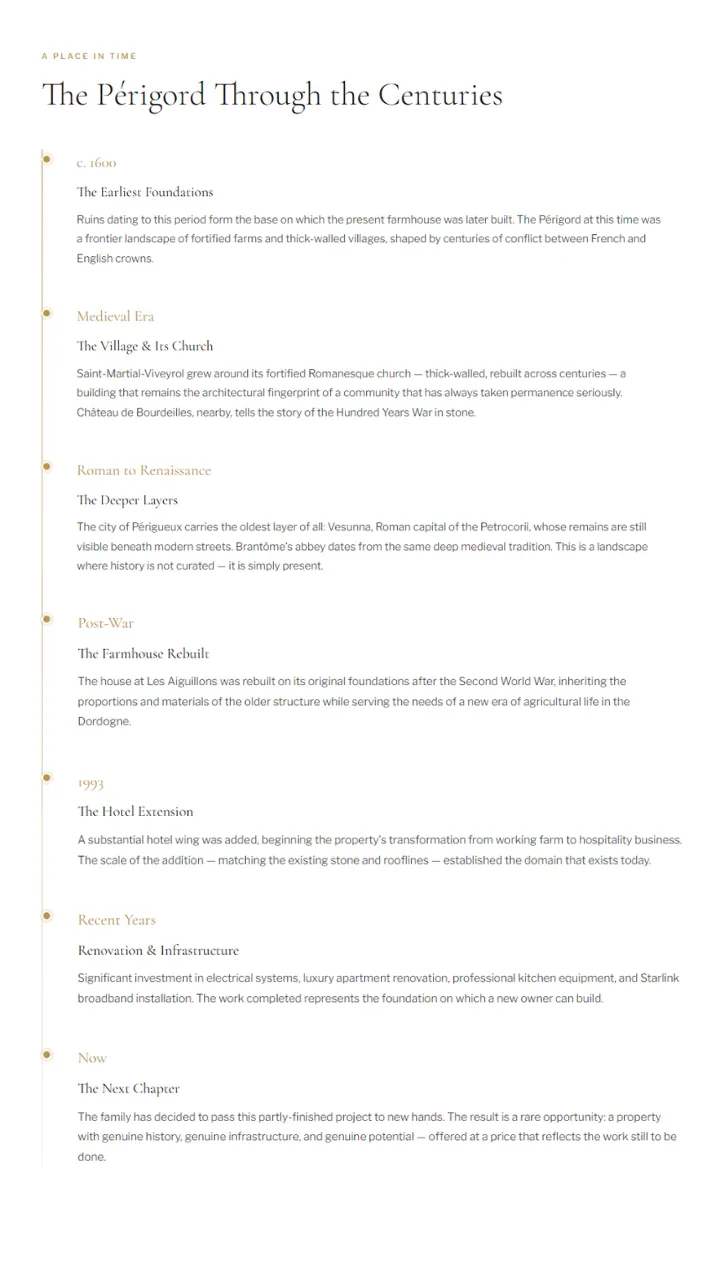
The oldest part of the estate dates to ruins traceable to around 1600 — a period when the Périgord was still defined by the administrative and military logic of the medieval frontier. The building types that survive from this era — fortified farmhouses, thick-walled manors, churches designed as much for shelter as for worship — speak to a world where security and permanence were hard-won.
By the time the house at Les Aiguillons was rebuilt on those foundations after the Second World War, the Dordogne had long settled into its role as one of France's most cherished agricultural landscapes: orchards, walnut groves, river valleys, and market towns where weekly fairs set the rhythm of life. The house carried those layers forward — old stone, new purpose.
In 1993, the hotel extension was added, and the property began its transformation into a hospitality business. The work that has been done since — the hand-carved stone fireplaces, the vaulted ceilings, the careful renovation of the apartments — has been done with respect for what was here before. This is not a property that has been modernised out of its character. It is a property where each generation has added to the story.

A Place in Time
The Périgord Through the Centuries
Les Aiguillons · Saint-Martial-Viveyrol · Dordogne · France